
 Trading Guides
$100 Trade Up Challenge: The Ultimate Guide to Winning
Think you can't get rich without cash? The $100 trade up challenge proves you wrong. Learn the exact strategy to turn a single C-note into your dream item.

You've heard the stories. A guy with one red paperclip trades his way to a house. A teenager flips a free phone into a Porsche. Sounds like a fantasy, right? It's not. It's the power of the trade up. And you don't need to start with something worthless. You can start with a Benjamin Franklin.
Welcome to the $100 trade up challenge. This isn't about spending cash. It's about using a single $100 asset as your launchpad to something incredible. Forget get-rich-quick schemes. This is a game of skill, patience, and strategy. This is your definitive guide to starting—and winning—your own bartering challenge.
What Exactly is a $100 Trade Up Challenge?
Let’s cut to the chase. A $100 trade up challenge is a modern spin on the legendary red paperclip trade. Instead of starting with a pocket-sized novelty, you kick things off with an item (or a tight bundle of items) valued at approximately $100.
The rules are simple: you can't add your own money. You can only trade. Each swap must be for an item of higher perceived or actual value. Your mission is to chain together a series of increasingly valuable trades until you reach a predetermined, high-value goal.
Why $100? It’s the sweet spot. It’s accessible enough for most people to acquire a starter item, but valuable enough to bypass the initial grind of trading up from near-zero. You’re skipping the boring first few levels and jumping right into the action.
This isn't just about acquiring stuff. It’s a challenge. A hustle. It's a tangible way to work towards your dream items without opening your wallet. It's proof that you can create massive value out of thin air with the right strategy. The end goal could be a down payment for a house, a specific dream car, or that Rolex you've been eyeing. The choice is yours, and the path starts with a single trade.
The Mindset: How to Think Like a Master Trader
Before you even pick your starter item, you need to get your head right. The tools and items matter, but the mindset is what separates the winners from the quitters. This is the psychology of the trade.
Value is Subjective
This is the golden rule. The value of an item is not its price tag; it's what someone is willing to give you for it. That boring old graphics card in your desk might be the final piece of someone else's dream gaming PC build. The jacket you never wear could be a grail item for a collector. Your job isn’t to sell an item; it’s to find the person who values it more than you do. You need to understand their story, their need, and position your item as the solution. This is the core of our bartering guide for beginners.
Patience is Your Superpower
Kyle MacDonald's trade from a paperclip to a house took a year and fourteen trades. This is a marathon, not a sprint. You will have periods where your item sits for weeks. You will get dozens of lowball offers. You will be tempted to take a “side-grade” just to feel like you’re making progress. Don’t. Master traders are patient. They wait for the right offer, not the first offer. Each day you hold your item is another day for the perfect trading partner to find you.
Embrace the "No"
Get ready to be rejected. A lot. Most of your trade offers will be ignored or declined. This is not a reflection of you or your item. It's just part of the process. Every "no" is simply data. Maybe your pictures aren't good enough. Maybe your description is weak. Maybe you're targeting the wrong audience. Or maybe it's just not the right fit. Don't get discouraged. Get analytical. Each rejection is one step closer to the enthusiastic "YES!" that moves you up the ladder.
Know Your Goal
Trading without a goal is like sailing without a rudder. You’ll just drift. You need a North Star. Define what you’re trading for. Is it a specific model of car? A down payment of $20,000? A vintage guitar? Write it down. Visualize it. This clarity will fuel your motivation when you’re stuck on a difficult trade. It helps you evaluate offers: “Does this trade get me closer to my goal?”
Your Starting Line: Choosing the Perfect $100 Item
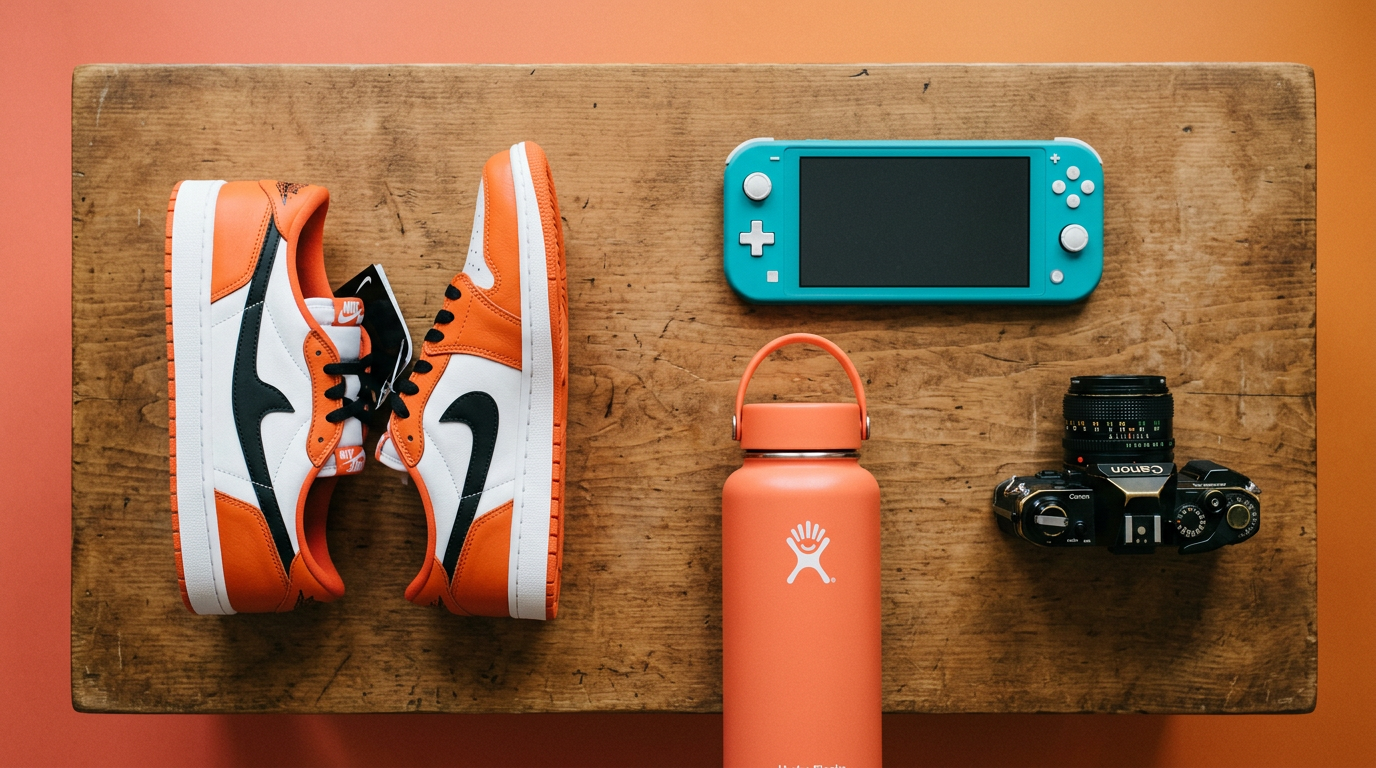
The first step is the most critical. Your starter item sets the tone for your entire journey. You want something with broad appeal, high perceived value, and good marketability. Don’t just grab the first $100 thing you see. Be strategic. Need more inspiration? Check our list of the best starter items for a trade up.
Here are some categories to get your brain working:
H3: High-Demand Electronics
These are always a safe bet. Technology moves fast, and people are always looking for deals on slightly older tech.
- Examples: A pair of used-but-pristine Apple AirPods (2nd Gen or Pro), a high-quality Bluetooth speaker (JBL Flip, Bose SoundLink), a Nintendo Switch Lite, an Amazon Kindle Paperwhite, or a popular gaming mouse from Razer or Logitech.
- Why they work: High brand recognition, easy to verify functionality, and constant demand. They are easy to photograph, describe, and ship, making them perfect for an item trading app like Flipuz.
H3: Niche Collectibles & Hobbies
If you have some domain knowledge, you can score big here. You're targeting passion.
- Examples: A rare or vaulted Funko Pop, a sealed Lego set from a popular theme (Star Wars, Harry Potter), a graded Pokémon or Magic: The Gathering card, a first-edition hardcover book, or a vintage film camera.
- Why they work: Collectors are driven by emotion and the thrill of the hunt. They are often willing to trade higher-value practical items for something that completes their collection. The key is authenticity and condition.
H3: Practical Gear & Tools
Utility never goes out of style. People always need things to solve problems or support their hobbies.
- Examples: A quality set of barely-used power tools (DeWalt, Milwaukee), a high-end bicycle component, premium camping equipment (a good 2-person tent from MSR or Big Agnes), a solid chef's knife, or a Yeti cooler.
- Why they work: The value is obvious. Someone who needs a tool for a weekend project right now is highly motivated to trade. These items hold their value well if they are from respected brands.
H3: Fashion and "Hype" Items
Tap into the world of trends and streetwear. This is high-risk, high-reward.
- Examples: A pair of popular sneakers in a common size (Nike Dunks, New Balance 550s), a used designer wallet or cardholder (Coach, Kate Spade), a limited-edition hoodie from a streetwear brand, or a stylish and sought-after watch (Seiko 5, Orient Bambino).
- Why they work: Scarcity and social proof drive immense value. If you can get your hands on a 'hot' item, you can attract offers far exceeding the original $100 value. You need to be fast, as trends can fade.
The Game Plan: Your Step-by-Step Strategy
You've got the mindset and the item. Now, it's time to execute. Follow this battle-tested plan.
Step 1: Document Your Origin Story Don't just snap a blurry photo. Clean your item until it shines. Find good, natural lighting. Take pictures from every angle. Include photos of any serial numbers, tags, or unique features. Then, write a killer description. Don't just list specs. Tell a story. “Starting my $100 trade up challenge with this pristine JBL speaker, aiming for a new mountain bike! Who wants to be the first step in the journey?”
Step 2: Get in the Game on Flipuz This is where the magic happens. Your journey needs a home. Flipuz is built for this. It's a dedicated community of traders. No selling fees eating into your value. The swipe-to-match interface makes finding potential trades fast, fun, and efficient. It's a gamified bartering app designed to connect you with your next big swap.
Step 3: The Art of the Swap When you get a match, be professional. Be friendly. State your goal clearly. Evaluate the offer objectively. Look at the item's marketability. Is it easier to trade than what you have now? Does it have a wider audience? Your goal on each trade is to increase value by at least 20-50%. You need to make a tangible leap forward with every swap.
Step 4: Rinse and Repeat Congratulations on your first successful trade! Now what? You do it all over again. Your new, more valuable item is your new starting line. Document it. List it. Find the next trade. This is the loop. With each cycle, your assets grow, and your big goal gets closer.
Step 5: Share Your Journey Don't trade in a vacuum. Post your progress on Instagram, TikTok, or Twitter. Tag @FlipuzApp. Use hashtags like #TradeUpChallenge and #100DollarChallenge. This does two things: it keeps you accountable, and it builds an audience. People who are invested in your story will actively help you, sending you leads and offers you'd never find otherwise.

Level Up Your Trades: Pro Tips for the $100 Challenge
Ready to move from amateur to pro? Use these advanced tactics to accelerate your journey.
-
Bundle and Unbundle: Sometimes the path forward isn’t one-to-one. Have two items worth $80 each? Bundle them to trade for a single $200 item. Conversely, if you have a single $500 item that's hard to move, consider trading it for two or three smaller, more liquid items that you can trade up individually.
-
Find the Inconvenience: Opportunity lies in other people's problems. Someone moving and needs to get rid of a huge, valuable piece of furniture by tomorrow? Their deadline is your leverage. Someone won a high-end laptop in a raffle but only uses Apple products? Their preference is your profit.
-
Master Local Arbitrage: An item might be common in your city but rare and desirable a few states over. Use Flipuz to connect with a national audience. A vintage surfboard that’s a dime a dozen in San Diego might be a hot commodity for someone in Chicago dreaming of the coast.
-
Add Value with Elbow Grease: Never underestimate the power of a good cleaning. A dirty, scuffed item looks cheap. A clean, polished item looks premium. Spend an hour detailing a bike, cleaning a pair of sneakers, or polishing a piece of silver. That small time investment can dramatically increase the perceived value and the quality of offers you receive.
-
Use the "And" Offer: If a trade is close but not quite right, sweeten the pot. Instead of just your item for theirs, offer “My item AND this brand-new charging cable for your item.” A small, useful kicker worth $10 can often close a gap of $50 in perceived value and make the other trader feel like they got a fantastic deal.
Ready to Start Your Legend?
The stories are real. The strategy is clear. The only thing missing is you. The difference between dreaming about a goal and achieving it is taking the first step. Kyle MacDonald started with a tiny red paperclip. You have a massive head start with a $100 asset.
The platform is built. The community of traders is waiting. Your journey from a single item to your ultimate dream doesn't have to be a fantasy. It can be your reality. It's time to stop reading and start doing.
Your $100 trade up challenge starts now. Download Flipuz and create your first listing for free.
FAQ
How long does a $100 trade up challenge take?
A $100 trade up challenge can take anywhere from a few months to over a year. The timeline depends entirely on your starting item, your goal, your strategy, and a bit of luck. The most important factor is patience. Rushing into bad trades will set you back further than waiting for the right one.
Is it better to start with one $100 item or multiple cheaper ones?
It's almost always better to start with a single, strong $100 item. A single, desirable item is easier to market, photograph, and describe. It creates a clearer story for your trading journey. Managing multiple small items is confusing and often leads to less valuable trade offers. Focus your value into one launchpad.
What if I get stuck with an item that won't trade?
Everyone hits a wall eventually. If an item isn't getting good offers for weeks, it's time to re-evaluate. First, try to improve your listing: take better photos, rewrite the description, and tell a better story. If that doesn't work, consider a “side-grade” to an item of similar value but with better marketability. In a worst-case scenario, a small “down-grade” to a much more liquid item can get you moving again.
How do I know if a trade is fair and safe?
Research is your best friend. Before accepting any trade, search for the other person's item on platforms like eBay (check sold listings), Facebook Marketplace, and other resale sites to gauge its true market value. On Flipuz, check user profiles and ratings. Always arrange to meet in a safe, public place. For a complete overview of best practices, read our guide on trading safety.
Stop reading. Start trading.
Pick a dream — house, car, Rolex, MacBook. Drop a starter item. Swipe. Flipuz handles the rest.