
 Trading Tips
TikTok Trade Up Challenge: From Paperclip to House Guide
You've seen the viral videos of people trading a bobby pin for a car. Here's the complete guide on how to win the TikTok trade up challenge yourself.

You’ve seen them. The viral videos flooding your For You page. Someone starts with a single bobby pin, a lone penny, or a humble paperclip. A few quick cuts, a dozen trades, and suddenly they’re holding the keys to a car, a deed to a tiny home, or even a plot of land. Welcome to the TikTok trade up challenge.
It’s captivating. It feels impossible. But it’s not magic. It’s the modern evolution of a classic hustle, rooted in the age-old practice of bartering. This isn't just about getting free stuff; it's a test of your wit, your charm, and your ability to see value where others don’t. It’s about the story.
This trend didn’t just appear out of nowhere. It’s the spiritual successor to one of the internet’s greatest legends: the story of Kyle MacDonald, who famously bartered his way from a single red paperclip to a house over the course of a year. He proved that with enough persistence and a great story, you can turn literally nothing into the ultimate prize.
Now, it’s your turn. You have the ambition. You have the dream. This guide will give you the strategy. We’ll break down the exact blueprint for starting your own bartering challenge, expose the common traps that derail most attempts, and show you the definitive tool to make your trade-up journey faster, safer, and more successful.
What Exactly Is the TikTok Trade Up Challenge?
At its core, the TikTok trade up challenge is a sequence of trades where you aim to increase the value of your item with each swap. You start with something of negligible or low value—think a pen, a hairpin, a rock—and you trade it for something slightly more valuable. You then take that new item and trade it for something better, and so on. The ultimate goal? To reach a high-value item you’ve been dreaming of, whether that's a new laptop, a vacation, a car, or even a house.
What makes it a TikTok challenge is the documentation. Each trade becomes a piece of content. The journey is the narrative. People follow along, rooting for you, suggesting trades, and becoming invested in your success. This public accountability and audience engagement is the secret sauce that fuels the modern trading phenomenon. It’s not just a transaction; it’s a show.
The appeal is multi-layered:
- The Thrill of the Hunt: It’s a real-life treasure hunt. You’re constantly searching for the next opportunity, the next person who has what you need and needs what you have. Every match feels like a victory.
- Zero-Cost Ambition: In a world where everything costs money, the trade-up challenge offers a path to acquiring incredible things with zero cash investment. It’s fueled by creativity and hustle, not your bank account.
- The Power of Story: Your followers aren't just watching you acquire items. They are following a character—you—on a quest. They celebrate your wins and commiserate with your setbacks. People who trade with you often do so just to be a part of that story.
Think back to the original inspiration. Kyle MacDonald didn't just post an ad saying, "Have paperclip, want fish-shaped pen." He created a blog, told a compelling story, and made people want to be the next chapter in his incredible journey. The TikTok challenge simply puts this on hyper-speed, using short-form video to build a narrative one trade at a time.
The Blueprint: How to Start Your Own Trade Up Challenge
Ready to get in the game? Don’t just jump in blind. Success requires a plan. Follow this blueprint to give yourself the best shot at turning your small start into a massive win.
Step 1: Choose Your Starter Item
This seems trivial, but it’s a critical first step. Your starter item sets the tone for your entire challenge. The ideal starter is small, universally understood, and has a bit of a story or quirk to it. You don't need to overthink it.
Look around you. A unique pen, a cool-looking rock, a bobby pin, an interesting keychain. The goal isn’t to find something of value, but something that can be a blank canvas for your story. Check out our guide to the best starter items for a trade up for more ideas. The key is to just pick something and start. Don't let analysis paralysis kill your challenge before it begins.
Step 2: Document Everything
This is what separates a private bartering project from a viral TikTok challenge. You are a storyteller first and a trader second. Document every single step.
- The "Before" Video: Create a compelling first video introducing your challenge. Show your starter item. State your outrageous goal. Tell people why you’re doing it. Make them want to follow along.
- Capture the Trade: When you make a trade, film the interaction (with permission, of course). If it's online, screenshot the conversation. Show the old item and the new item side-by-side.
- Create a Series: Use TikTok’s series or playlist feature. Number your videos: “Trade Up Challenge: Part 1,” “Part 2,” and so on. This makes it easy for new followers to binge-watch your journey from the beginning.
Your content is your leverage. A well-documented journey with a growing audience makes your items more desirable. People will trade for a slightly less valuable item if it means they get a shoutout to thousands of followers.
Step 3: Find Your Trading Platform
This is where most people fail. They start with energy, but they don't know where to find the right people to trade with. Knocking on doors like Kyle MacDonald is not a scalable strategy in 2024. Using Facebook Marketplace or Craigslist is a nightmare—they are designed for selling, not trading. You'll be flooded with lowball cash offers, spam, and flaky people who waste your time.
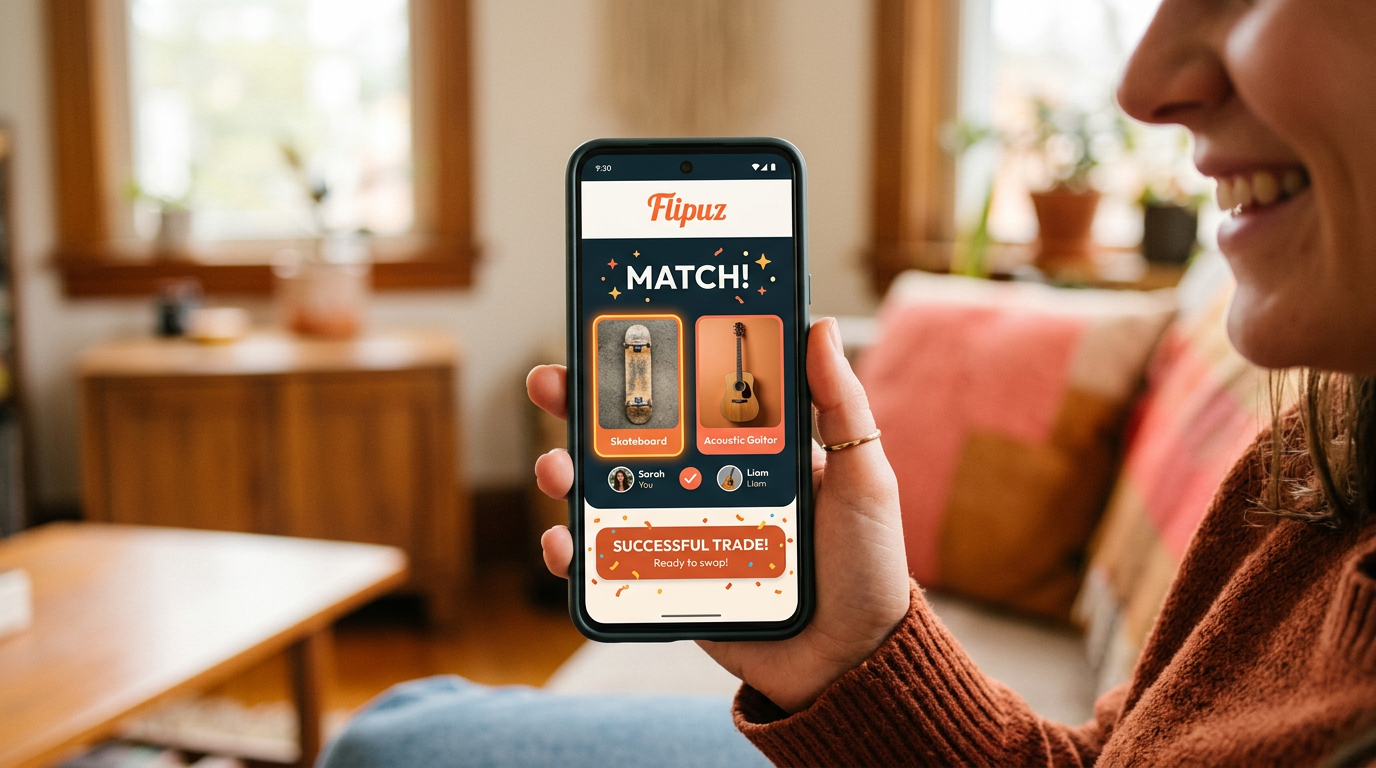
This is where Flipuz changes the game. Our app was built from the ground up for one purpose: trading items. No cash, no fees, no distractions. It's a community of people who understand the trade up mindset. You swipe on items you like, and if they like your item back, it’s a match. It’s the fastest, most efficient way to find your next trade and keep your momentum going. Ready to see for yourself? Start your challenge on Flipuz now.
Step 4: Make the Ask
Once you find a potential trade, you need to pitch it. Don't just say, "Wanna trade?" Sell the story. Explain the challenge. Let them know they will be part of your next video. Frame it as a win-win. They get an item they want, and they get to be part of a cool internet project.
Be confident. Value is subjective. The old office chair you just acquired might be junk to you, but it could be the perfect upgrade for a student who is currently using a milk crate. Understand their needs and explain how your item solves their problem. Confidence and a good story are your most valuable assets.
Step 5: Rinse and Repeat
One trade is a transaction. A series of trades is a journey. The key is persistence. You will get stuck. You will have an item that nobody seems to want. This is normal. The trick is to stay flexible. Sometimes you need to make a lateral trade—one for an item of similar value—just to get something new and more desirable into your inventory. Don’t get discouraged. Every “no” gets you closer to a “yes.” Keep swiping, keep pitching, and keep telling your story.

The Psychology Behind a Successful Trade Up
Why does this even work? Why would someone trade their perfectly good item for something you have, especially in the early stages? It comes down to a few key psychological drivers.
First, there’s the power of narrative. Humans are wired for stories. When you present your trade as part of a grander quest, you’re not just offering an object; you’re offering someone a role in an unfolding adventure. People will often make a slightly uneven trade just for the novelty and the social currency of being able to say, “I was part of that viral trade up challenge.” It’s why we also wrote about the psychology of trading up; it's a fascinating subject.
Second is the concept of subjective value. The old adage “one person’s trash is another’s treasure” is the entire economic engine of a bartering challenge. That old video game console collecting dust in your closet is worthless to you. To a collector or a student on a budget, it has immense entertainment value. A successful trader is an expert at identifying these value mismatches and positioning their item to the right person at the right time.
Finally, there’s the human element. Trading is social. It requires communication, negotiation, and building a sliver of trust. Being likable, transparent, and enthusiastic goes a long way. People are more likely to trade with someone they connect with. This is a social game as much as it is an economic one. Your personality can add perceived value to any item you hold.
Common Pitfalls of the Bartering Challenge (And How to Avoid Them)
For every viral success story, there are a thousand failed attempts that fizzled out after two or three trades. They almost always fall into the same traps. Here’s what to watch out for.
Pitfall 1: Scams and Safety
The internet can be a sketchy place. Meeting strangers from Craigslist or Facebook Marketplace carries inherent risks. They might not show up, the item might not be as described, or worse. Your personal safety is paramount and non-negotiable.
How to Avoid It: Use a platform with safety in mind. On Flipuz, you can check user profiles and trade history. We provide clear guidelines and best practices for meeting up to trade. Never put yourself in a risky situation for a trade. Public, well-lit places are your friend. Read our full take on safety to be prepared.
Pitfall 2: Losing Momentum
You traded your pen for a book, the book for a coffee maker, and now… crickets. You’ve been stuck with the coffee maker for weeks. This is the great filter. Momentum is everything, and losing it is the #1 killer of trade up challenges.
How to Avoid It: Be flexible. If you can’t trade “up,” trade “laterally.” Swap your coffee maker for a skateboard of similar value. It might not feel like progress, but you now have a completely different item to market to a whole new audience. Also, use a dedicated trading app where the pool of potential traders is large and active. More users mean more chances to find your match and keep the engine running.
Pitfall 3: Overvaluing Your Items
You’ve grown attached to that coffee maker. You cleaned it, you made a great video about it, and you’re convinced it’s worth a brand-new drone. This is a fatal mistake. Sentimental value does not equal market value.
How to Avoid It: Stay objective. Do a quick search on eBay or Facebook Marketplace to see what your item is actually selling for. Be realistic. Remember, you need someone to see enough surplus value in their own item to make the swap. If your asking price is inflated by your ego, you’ll never find a trade.
Pitfall 4: Poor Storytelling
Your videos are blurry, your captions are boring, and you’re not engaging with your comments. You’re just posting a picture of an item with the caption “trade?” You’re missing the entire point.
How to Avoid It: Treat yourself like a content creator. Use trending sounds on TikTok. Write compelling captions. Ask your audience for advice on what to trade for next. Reply to comments. The more you invest in the story, the more invested your audience becomes, and the more leverage you have in your trades.
Why Use an App? Trading in the Digital Age
Let's be blunt. The old way of trading is broken. It was a novelty when Kyle MacDonald did it because the tools weren't available. Today, using general marketplaces for a specific task like bartering is like trying to chop vegetables with a hammer. It’s the wrong tool for the job.
Those platforms are built around one thing: cash transactions. Their algorithms, user interface, and community expectations are all geared towards buying and selling. When you try to barter, you’re swimming against the current. You’re a weirdo in a world of buyers and sellers.
This is why Flipuz exists. We built the platform we wished we had for our own trade up challenges.
The Flipuz advantage is clear:
- Built for Bartering: The entire ecosystem is designed for item-for-item swaps. No cash allowed. No price tags. Just pure trading.
- Swipe, Match, Swap: We took the addictive, intuitive interface of modern dating apps and applied it to trading. It makes finding your next trade fast, fun, and efficient. No more endless scrolling through irrelevant listings.
- Zero Fees: We mean it. No listing fees, no transaction fees, no hidden charges. It’s completely free. Your hustle is your own.
- A Dedicated Community: Every single person on Flipuz is there to trade. You don't have to explain the concept of bartering. Everyone gets it. You're all on the same team.
Stop trying to make the wrong tools work. Stop wasting your time with flakes and scammers on platforms that weren't built for you. The TikTok trade up challenge is about momentum, and nothing kills momentum faster than friction.
Flipuz is the frictionless way to trade. It’s time to stop watching other people’s journeys and start your own. Your dream of trading up to a car, a Rolex, or a down payment on a house is possible, but it starts with the right first step.
Download Flipuz and start your trade up challenge today. Your first trade is just a swipe away.
FAQ
Is the TikTok trade up challenge real?
Absolutely. While some of the most extreme examples (like getting a house in a week) may be staged or exaggerated for views, the core concept is very real and achievable. Thousands of people have successfully traded from low-value items to things like laptops, bikes, cars, and vacations by using persistence and smart trading strategies. It's a modern take on the classic bartering system.
What is the best item to start a trade up with?
There's no single "best" item, but a great starter is typically small, easy to trade, and has a unique quality. Think of items like a single red paperclip, a unique pen, a vintage keychain, or even a cool-looking rock. The goal isn't the item's initial value, but its ability to start a conversation and a story. The more unique and easy to explain, the better.
How long does a trade up challenge take?
The timeline varies wildly depending on your goal, your strategy, your location, and a bit of luck. A trade for a new phone might take a few weeks or months. A trade for a car could take a year or more. The original red paperclip trade for a house took Kyle MacDonald one year. The key is to be persistent and focus on consistent, steady progress rather than a specific deadline.
Is trading items online safe?
It can be, as long as you take precautions. Always use a platform with user profiles and a sense of community. When meeting to trade, always choose a public, well-lit place like a coffee shop or a police station's designated safe trade zone. Trust your gut; if a trade or a person feels off, walk away. Your safety is always more important than any item.
Stop reading. Start trading.
Pick a dream — house, car, Rolex, MacBook. Drop a starter item. Swipe. Flipuz handles the rest.