
 Trading Tips
How to Start a Trade Up Challenge That Actually Works
Stop dreaming and start doing. Learn the exact steps to launch your own bartering journey, inspired by the legendary red paperclip trade, and turn junk into treasure.

You’ve heard the story. A guy starts with a single red paperclip and, through a series of trades, ends up with a two-story farmhouse. It sounds like a modern fairy tale, but it’s a true story. And it’s a blueprint. That journey, known as a trade up challenge, is your ticket to getting what you want without spending a dime.
Maybe your goal isn't a house. Maybe it’s a car, a vintage Rolex, or just the thrill of the chase. Whatever it is, the path is the same: start small, trade smart, and build momentum. Forget theory and fluff. This is your practical, step-by-step guide on how to start a trade up challenge that gets results. The only question is, are you ready to play?
What Exactly Is a Trade Up Challenge?
At its core, a trade up challenge is a personal bartering quest. You start with an item of little to no monetary value and trade it for something slightly more valuable. You then trade that new item for another, slightly more valuable item. You repeat this process, climbing the value ladder one swap at a time, until you reach your ultimate goal.
The concept was immortalized by Kyle MacDonald, the guy behind the famous one red paperclip trade. He proved that with persistence, creativity, and a good story, you can turn a common office supply into a life-changing asset. His journey took him from the paperclip to a fish-shaped pen, a doorknob, a camping stove, a generator, a snowmobile, a trip to Yahk, a cube van, a recording contract, a year's rent in Phoenix, an afternoon with Alice Cooper, a KISS snow globe, a role in a movie, and finally, a house.
This isn't about getting rich quick. It's a game of patience, negotiation, and finding what other people value. The beauty of this bartering challenge is that value is subjective. Your dusty comic book might be worthless to you, but it could be the missing piece for a collector who’s willing to trade you their old guitar. That guitar then becomes your next piece on the board. In the past, this meant scouring Craigslist or hitting up flea markets. Today, you can do it all from your phone.
Step 1: Set Your Goal (The 'Why')
You wouldn't start a road trip without a destination. The same goes for your trade up challenge. Before you even think about your first item, you need to define your finish line. What are you trading for? Be specific. Don't just say "something cool." Name it.
- A Car? What make and model? See it in your mind's eye.
- A House? Where? What does it look like?
- A Luxury Watch? Which one? A Rolex Submariner? An Omega Speedmaster?
Your goal is your fuel. When you're on your tenth trade and feeling stuck with a slightly-used lawnmower, remembering that you're chasing a down payment for a condo will keep you going. Your 'why' provides the narrative for your entire journey, making it more compelling for both you and your future trading partners.
Need some inspiration? Check out the big-ticket items others are chasing on our Dreams page. Seeing other people's ambitious goals makes your own feel more attainable. Write your goal down. Stick it on your wall. Tell your friends. Make it real. A vague wish gets you nowhere. A concrete goal gives you a target to aim for.
Step 2: Choose Your Starter Item
This is your genesis block, your 'one red paperclip.' The importance of this first item isn't its value—it's its story potential and its ability to get you your first trade. The barrier to entry should be non-existent.
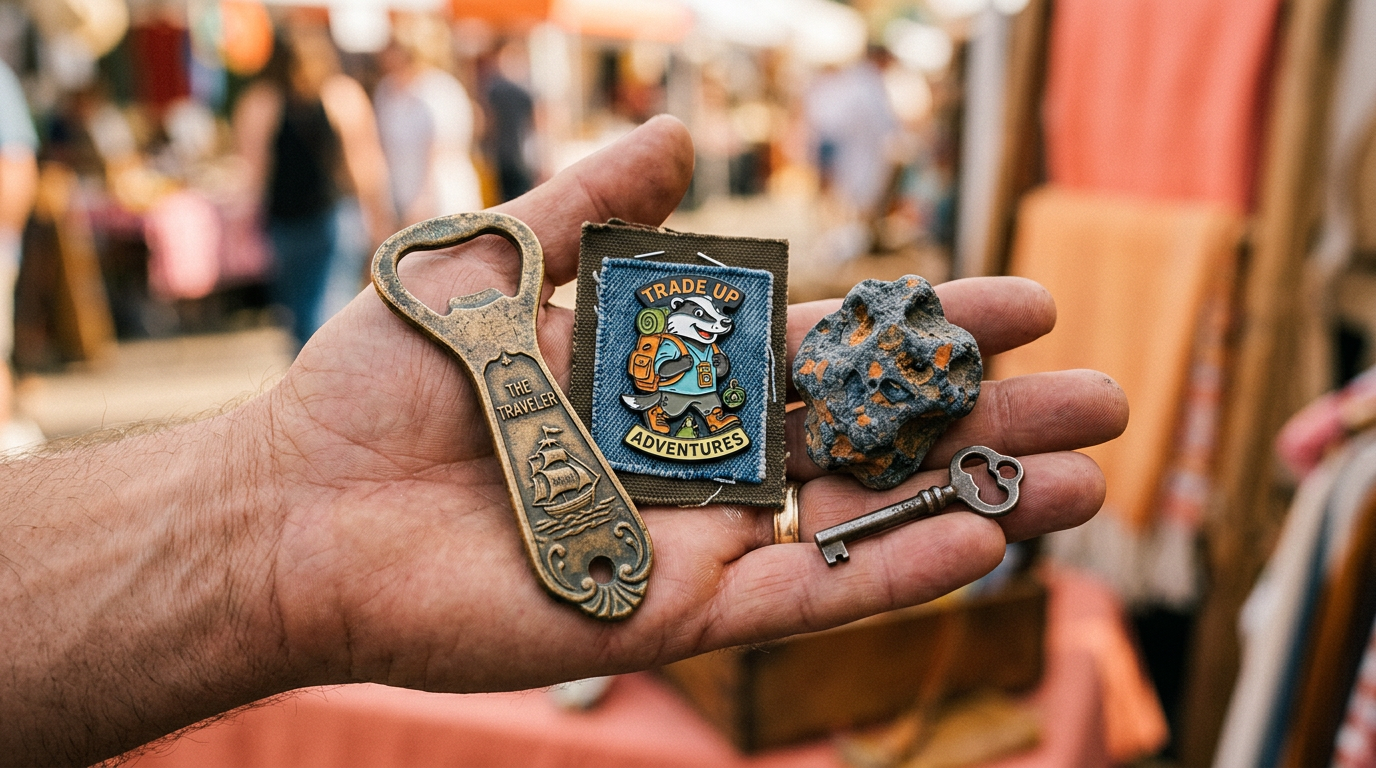
So, what to start a trade up challenge with? Don't overthink it. Look around your room. What do you have that's small, interesting, but ultimately expendable? Here are the characteristics of a great starter item:
- Low to No Monetary Value: This removes any fear of loss. You're trading up from nothing.
- Unique or Quirky: A strange souvenir, a vintage pin, a book with an interesting inscription. Uniqueness creates a talking point.
- Portable and Easy to Ship: Your first few trades might be local, but as you scale, you'll want something easy to handle.
- Something with a Story: Can you tell a quick, engaging story about the item? "This is the pen I used to write my first novel" is more interesting than "it's a pen."
For a deep dive into proven first items, read our guide on the best starter items for a trade up. The goal of your first trade isn't to double your value. It's simply to make a trade. Any trade. Breaking that initial inertia is the single most important step. Find your paperclip, and you're officially in the game.
Step 3: Define Your Trade Up Challenge Rules
Every great game has rules. They provide structure, keep you honest, and create a level playing field. While you're the master of your own challenge, establishing a clear set of trade up challenge rules from the start will guide your decisions and make your journey more legitimate to followers.
Here are a few non-negotiable rules you should adopt:
- No Cash Allowed. Period. This is the golden rule of bartering. You cannot accept or offer money as part of a trade. The moment cash enters the equation, it's no longer a trade up challenge; it's just a garage sale. This rule forces creativity.
- Trades Must Increase Perceived Value. You must always be 'trading up.' Value is subjective, so this is about your perception and your ability to justify the trade. Can you make a case that the new item is a step up from your old one? If not, don't make the deal.
- Document Every Single Trade. Take pictures or videos of your current item and the item you receive. Record the date, the person you traded with (with their permission), and the story behind the swap. This documentation becomes your proof of work.
- Be 100% Transparent. Honesty is your currency. Be upfront about the condition of your items, any flaws, and your ultimate goal. People are more willing to help someone on an honest mission than someone who seems shady.
Consider adding personal rules to raise the stakes. Maybe you set a timeline—achieve your goal in one year. Or perhaps you limit yourself to a specific platform, like only using the Flipuz app. Your rules define your game. Write them down and stick to them.
Step 4: Find Your Trading Partners
You have your goal, your starter item, and your rules. Now you need people to trade with. This is where most challenges fizzle out. Knocking on doors like Kyle MacDonald did is romantic, but it's 2024. You need a more efficient strategy.
The old way involves blasting messages on Facebook Marketplace, Craigslist, or Reddit. You'll spend 90% of your time explaining what a trade up challenge is, dealing with lowballers offering cash (violating rule #1), and dodging scammers. It's a slow, painful grind.
The new way is to go where the traders are. You need a dedicated ecosystem of people who already understand the art of the swap. You need Flipuz.
Think about it. On Flipuz, everyone is there for one reason: to trade real items. You don't have to explain the concept. You don't have to sift through endless 'for sale' listings. It's a curated pool of potential partners who are ready to deal. Our swipe-and-match system cuts through the noise. You see an item you want, you swipe right. If they like your item, it's a match. It's the fastest way to find a mutually beneficial trade.
Stop wasting time trying to convert sellers into traders. Go directly to the source. Ready to find your first trade in the next 10 minutes? Get on Flipuz and start your challenge now.

Step 5: Master the Art of the Pitch
Simply listing your item isn't enough. You are not just swapping an object; you are selling a story. Your pitch is what convinces someone that trading with you is more interesting than trading with anyone else.
Your pitch has two parts: the story of your challenge and the story of your item.
First, lead with the mission. Start your messages or profile description with, "I'm on a trade up challenge to turn this [Your Item] into a [Your Goal]." This immediately frames the interaction. You're not just a random person; you're on a quest, and they can be a part of it. People love being a character in a great story.
Second, make your item compelling. Don't just list specs. Find the angle.
- Bad Pitch: "Have: used coffee maker. Works fine."
- Good Pitch: "This coffee maker has fueled three all-nighters that helped me ace my finals. It’s got good karma. I'm trading it up to hopefully get one step closer to a reliable car for my new job."
See the difference? The good pitch connects the item to a human experience and links it back to the larger goal. Be authentic, be enthusiastic, and be clear about what you're looking for. A great pitch isn't about deception; it's about connection. Find the mutual win and you'll find your next trade.
Step 6: Document and Share Your Journey
If a trade up challenge happens in the forest and no one is around to see it, does it make a sound? Yes, but you miss out on your biggest asset: public momentum.
Documenting your journey is not just for your personal scrapbook. It's a strategic tool for attracting bigger and better trades. When people can see your progress—from a paperclip to a pen to a doorknob—they become invested. They'll start rooting for you. And some of them will have the very item you need for your next step up.
Here’s your content plan:
- Choose Your Platform: TikTok and Instagram Reels are perfect for short, punchy video updates. A blog or a dedicated Instagram account works well for more detailed storytelling.
- Create a Signature Format: Start every update the same way. "Trade Update #7! I traded my [Old Item] for this incredible [New Item]!"
- Show, Don't Just Tell: Post high-quality photos and videos of your items. Film the moment of the trade (with permission). Let people see the journey unfold.
- Use Hashtags: Leverage tags like #tradeupchallenge, #papercliptochallenge, #barter, #fliplife, and #tradingup. This helps new people discover your quest.
As your audience grows, you'll shift from hunting for trades (outbound) to receiving offers (inbound). People will reach out to you, wanting to be the next chapter in your story. This is how you land the game-changing trades—the snowmobiles, the recording contracts, the houses. Your story becomes your leverage.
You're Ready. Stop Reading and Start Trading.
That's it. That's the playbook. We’ve covered everything from setting your impossible goal to picking your humble starter item and leveraging a story to make it happen. You now know more about how to start a trade up challenge than 99% of people who just dream about it.
Knowledge is useless without action. The single hardest part of this entire process is making that first trade. It feels awkward. You might get rejected. But once you do it, the seal is broken. You're no longer a spectator; you're a player.
The theory is over. It's time to act. Your paperclip is waiting. Your dream car, watch, or house is on the horizon, one smart swap at a time. The question is no longer how. It's when.
Download Flipuz and make your first trade today.
FAQ
What's the best item to start a trade up challenge with?
A good starter item is small, has a low monetary value, and ideally, a bit of personality or a story. Think of a unique pin, a book with an inscription, a cool-looking rock, or a foreign coin. Its main purpose is to be easy to trade away to break the ice. Check out our guide on the best starter items for a trade up for more ideas.
How long does a trade up challenge take?
There's no set timeline. It can take months or even years. Kyle MacDonald's famous journey from a paperclip to a house took exactly one year. The duration depends entirely on your goal's scale, your persistence, your negotiation skills, and a bit of luck. It's a marathon, not a sprint, so be prepared for the long haul.
Is it really possible to trade up to a house?
Yes, it is absolutely possible. The one red paperclip story is the ultimate proof of concept. While it requires an incredible amount of dedication, networking, and storytelling, the fundamental principle of climbing the value ladder through bartering is sound. It's the ultimate test of the trade up challenge.
How do I know if a trade is fair?
Value is subjective, which is the magic of bartering. A trade is 'fair' when both you and your trading partner feel you are walking away with something you want more than what you gave up. There's no objective formula. On an app like Flipuz, the match itself is a signal of fairness; it means both of you saw desirable value in what the other person had to offer.
Stop reading. Start trading.
Pick a dream — house, car, Rolex, MacBook. Drop a starter item. Swipe. Flipuz handles the rest.