
 Trading Guides
Trade Up Challenge Rules: Your Ultimate 2024 Playbook
So you want to trade your way to a car or a house? It's not magic, it's a game with a playbook. These are the unwritten trade up challenge rules you need to master.

You’ve seen the stories. The person who started with a bobby pin and ended up with a car. The legend of Kyle MacDonald, who masterminded the original red paperclip trade and bartered his way to a two-story farmhouse. It sounds like a modern fairytale, but it’s not. It’s a game. A challenge. And like any game worth playing, it has rules.
But here’s the secret: there is no official rulebook. There’s no governing body for the trade up challenge. This lack of structure is both liberating and daunting. It means you can’t truly break the rules, but you can definitely fail the challenge. Consider this your playbook. These aren't rigid laws; they are the core principles, the unwritten trade up challenge rules that separate the legends from the people who get stuck with a slightly better paperclip.
Ready to turn your pocket lint into property? Let's dive in.
The Prime Directive: No Cash Allowed
This is the soul of the challenge. The one rule you cannot break. The entire point of a trade up is to create value out of thin air, using nothing but items and your own ingenuity. The moment money enters the equation, it’s not a trade up challenge anymore—it’s just a garage sale.
Why is this so critical? Because the no-cash rule forces you to think differently. You can't just slap a price tag on something. You have to assess its intrinsic value. What problem does it solve? Who would find it desirable? What story does it tell? This constraint is the engine of creativity that drives the entire journey.
What counts as cash? It's more than just paper bills.
- Cash, Checks, Wire Transfers: Obviously out.
- Gift Cards: This is a gray area, but we say no. A gift card is essentially store-specific currency. It violates the spirit of the game.
- Cryptocurrency: Absolutely not. It’s a direct monetary transaction.
- "Cash plus item" deals: A hard no. The challenge is to trade item-for-item.
Your mission is to find someone who wants what you have more than they want what they have. It’s a pure exchange of perceived value. A successful trade isn’t about one person getting a “good deal.” It’s about two people walking away happy. Sticking to the no-cash rule preserves the integrity of your challenge and makes the final achievement that much sweeter.
Rule #1: Start Small, Think Grand
The first trade is the most important. Not because of its value, but because of its power to get you started. The beauty of the original red paperclip story is the absurdity of the starting point. It was worthless. And because it was worthless, there was zero risk. Kyle MacDonald had nothing to lose.
This is a psychological masterstroke. If you start with something you value, like a decent laptop, you'll be terrified of making a bad trade. You'll overthink it. You'll freeze. But if you start with a novelty pen, a unique-looking rock, or a vintage bottle opener? The pressure is off. Every single trade from that point forward is pure profit.
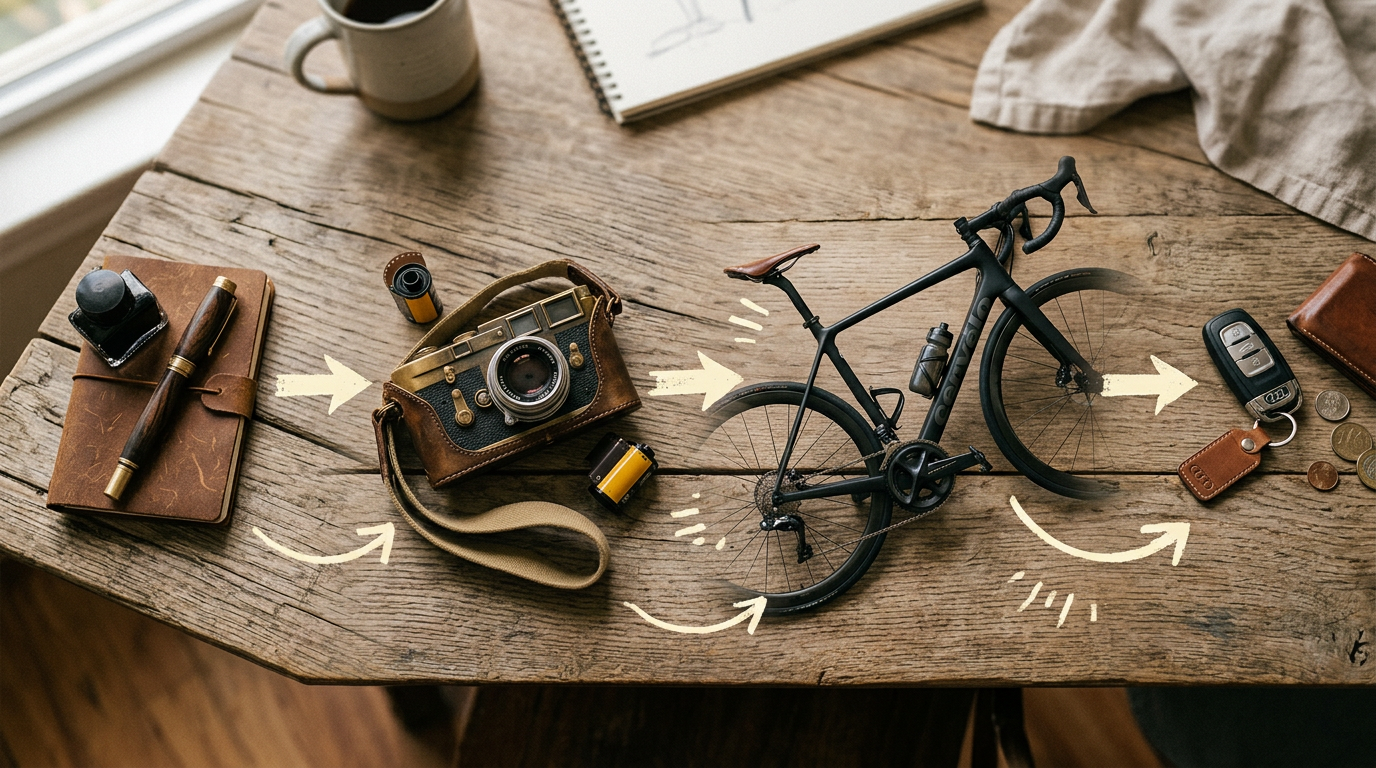
Your first item should be a conversation starter. Something with a tiny spark of interest. Check out our guide on the best starter items for a trade up for inspiration. The goal of your first trade isn't to double your monetary value; it's to get the ball rolling and prove the concept to yourself. Trade that quirky pin for a used book. Trade that book for a simple tool. You're not just trading items; you're building momentum.
Rule #2: Document the Journey
In the pre-social media era, Kyle MacDonald used a blog to tell his story. Today, you have TikTok, Instagram, YouTube, and more. If you aren't documenting your trade up challenge, you're competing with one hand tied behind your back. This isn't just a rule of the game; it's a critical strategy for winning it.
Why? Because people don't just care about the items; they care about the story. They want to follow your journey, root for your success, and share in the excitement of each trade. A well-documented challenge builds an audience, and an audience is your most powerful asset. Every follower is a potential trader or someone who knows a potential trader.
Here’s how to do it right:
- Be Authentic: Show the wins and the near-misses. Talk about your thought process. Let your personality shine. People connect with people, not just a series of transactions.
- High-Quality Visuals: Take clear, appealing photos and videos of your items. Show them in use. Tell their story.
- Create a Narrative: Each trade is a chapter. The person you traded with is a character. Frame your updates as part of an epic quest. This is especially potent on platforms like TikTok, as seen in the viral TikTok trade up challenge.
- Use Hashtags: Leverage hashtags like #tradeupchallenge, #barter, #papercliptohouse, and your own unique challenge hashtag to attract viewers.
Documenting your journey transforms you from a random person trying to trade stuff into a public figure on a mission. It creates social proof, builds trust, and exponentially increases your chances of finding that perfect next trade. People will want to be a part of your story.
Rule #3: Define Your "Up"—Value Is Subjective
This is where the art of the trade comes in. “Trading up” doesn’t always mean trading for something with a higher price tag. If you get bogged down in pure dollar-for-dollar valuation, you'll miss the best opportunities. Value is subjective, and you need to become a master at seeing it from different perspectives.
An “up” trade can mean moving toward:
- Higher Monetary Value: The most obvious, but not always the most strategic.
- Broader Appeal: Trading a niche collectible for a popular electronic device like a smart speaker might feel like a sideways move, but the speaker has a much larger pool of potential traders for your next step.
- Higher Portability/Shippability: Early in your challenge, a huge, heavy item can be a dead end. Trading a bulky piece of furniture for a high-end camera makes your next trade infinitely easier to execute.
- Niche Value: Sometimes, the key is to trade a common item for something intensely desirable to a specific subculture (e.g., a gaming accessory for a rare comic book). You narrow your audience but dramatically increase the passion and willingness to trade within that group.
Think about context. A snowblower is practically worthless in Miami but incredibly valuable in Buffalo. A vintage surfboard is gold in Southern California but dead weight in Kansas. Mastering this principle is central to any good bartering guide for beginners. Your job is to find the gap between how much you value an item and how much your trading partner values it. That gap is where successful trades live.

Rule #4: The Human Element: Don't Be a Jerk
You can have the best item and the best story, but if you have a bad reputation, your challenge is over. Every trade involves another human being. How you treat them matters more than anything.
This is about playing the long game. Your goal should be a win-win scenario every time. The other person should walk away feeling great about the trade, like they got something they truly wanted. If they feel tricked or hustled, they will talk. In the digital age, a bad reputation spreads instantly and is impossible to erase.
Follow these principles:
- Be Honest: Be transparent about your item's condition. If it has flaws, point them out. Trust is your currency.
- Be Reliable: Show up on time. Communicate clearly. Don't ghost people. Basic respect goes a long way.
- Be Safe: Always prioritize your personal safety. Meet in public, well-lit places. Use a platform with built-in user verification and secure messaging. Flipuz has strict community guidelines and resources on trading safety for this very reason.
- Be Gracious: Thank every person you trade with, whether they're the first trade or the last. They are a part of your story. Acknowledge them in your documentation (with their permission). This builds goodwill that will pay dividends down the line.
Remember, you're not just trading an item. You're building a network of people who believe in your quest.
Rule #5: Aim for a Dream, But Embrace the Detour
Having a big, audacious goal is what makes the challenge compelling. You’re not just trading for the sake of trading; you’re on a quest for a house, a specific car, or that grail-watch Rolex. This dream goal gives your journey direction and purpose. It’s your North Star.
However, the path to that star is never a straight line. You will have to take detours. You will make sideways trades. You might even make a trade that feels like a step back in order to reposition yourself for a giant leap forward two trades later.
Don't be so fixated on the final goal that you become rigid. If your goal is a car, but someone offers you a small boat that you know is highly sought after in your lakeside community, take the boat! The boat might be the key that unlocks the trade for the car. Flexibility is a superpower in the trade up challenge.
This is where a tool that helps you manage your goals becomes invaluable. On the Flipuz app, you can declare your Dream Items, making your intentions clear to the whole community. It lets others know what you’re working towards, turning thousands of users into scouts for your next perfect trade.
Your Secret Weapon: The Flipuz App
You know the rules. You understand the strategy. Now, you need the arena. Doing a trade up challenge using scattered tools like Craigslist, Facebook Marketplace, and DMs is like trying to build a house with a spoon. It’s messy, inefficient, and unsafe.
Flipuz is built for this. We are the home of the trade up challenge.
Think about it. We eliminate the friction. The swipe-to-match system is designed for discovering items and people you wouldn't have found otherwise. It’s all item-for-item, honoring the no-cash rule at its core. Our platform is free. No listing fees, no transaction fees, no nonsense. It’s just you, a community of traders, and a clear path to your goal.
Stop thinking about how you'll find people. Stop worrying about organizing your DMs. The entire framework is waiting for you.
Ready to start your own legendary journey? Sign up for Flipuz and make your first trade today. Your paperclip is waiting.
FAQ
What are the official rules for the trade up challenge?
There are no “official” rules, as there's no single governing body. The community has largely adopted a set of principles, the most important being the “no cash” rule. The rest of the “rules” are more like strategies for success: start small, document your journey, be a good person, and focus on subjective value.
How long does a trade up challenge take?
It varies wildly. The original red paperclip trade took Kyle MacDonald one year and fourteen trades to get a house. Some TikTok challenges reach a car in a few months. Others can take several years. It depends on your goal, your strategy, your location, and a bit of luck. It's a marathon, not a sprint.
Can you lose value in a trade?
Absolutely, and you should expect to at some point. Not every trade will be a home run. You might trade for an item you thought was desirable, only to find it has a very small market. Don't get discouraged. This is part of the game. The key is to learn from the mistake, understand why it happened, and use that knowledge to make a smarter trade next time.
What's the best item to start a trade up challenge with?
Forget the literal paperclip. The best starting item is something small, inexpensive, but unique or interesting. It should be easy to carry and photograph. Think of a fountain pen, a unique lapel pin, a small art print, or a vintage tool. We have a whole guide on the best starter items for a trade up to get your creative juices flowing.
Stop reading. Start trading.
Pick a dream — house, car, Rolex, MacBook. Drop a starter item. Swipe. Flipuz handles the rest.