
 Trading Tips
The $20 Trade Up Challenge: From Pocket Change to Profit
Stop just dreaming of the red paperclip trade. Here's your guide to starting the $20 trade up challenge, turning a small item into your ultimate prize.
You have a $20 bill. You see people on TikTok and YouTube starting with a cheap item and trading their way up to cars, tiny homes, and jaw-dropping windfalls. You’ve heard the legend of the red paperclip trade and thought, “I could do that.”
Guess what? You can. And you don’t need a huge budget or a lucky break. You just need a plan.
This isn’t just another article hyping up a trend. This is your playbook for the $20 trade up challenge. We’ll break down the strategy, the psychology, and the exact steps you need to take to turn that twenty into your next big win. Forget daydreaming. It’s time to start doing.
What Exactly Is The $20 Trade Up Challenge?
Let’s get the definition straight. The $20 trade up challenge is a personal quest where you start by purchasing an item for $20 or less. Your mission, should you choose to accept it, is to trade that item for another item of slightly higher perceived value. You then take that new item and trade it for something better. You repeat this process, climbing the value ladder one swap at a time until you reach a specific goal or a point of significant profit.
It’s the modern version of an age-old practice. Bartering is human nature. But this challenge gamifies it. It’s not just about getting something for nothing; it’s about understanding value. And value, you’ll quickly learn, is completely subjective.
The person who gives you a $50 vintage jacket for your $20 rare book isn’t being ripped off. They’re getting exactly what they want. They might be a book collector who has been searching for that specific edition. Your book has more value to them than their jacket. This is the core principle you must grasp: you’re not a con artist. You’re a value facilitator. You connect items with people who will appreciate them most.
This barter challenge is a direct descendant of Kyle MacDonald’s famous journey from one red paperclip to a literal house. While you might not be aiming for a two-story home on your first try, the potential is very real. People have successfully traded up to cars, vacations, and their dream Rolex watch. The journey is the reward, but the prize at the end can be life-changing. It's about trading from nothing to something substantial, using wit and strategy instead of your wallet.
Why $20? The Psychology of the Starting Line
Why not $5? Or $50? Or the $100 trade up challenge? The twenty-dollar mark is the sweet spot for a reason. It hits a perfect psychological balance of being accessible yet requiring thought.
First, the barrier to entry is almost non-existent. Most people can find a spare $20. This isn't an investment strategy that requires a portfolio; it's an adventure that requires pocket change. That low financial risk removes the fear of failure. If your first trade is a bust, you’re out the cost of a few coffees. This encourages bold moves and experimentation, which are critical for success. This is a game, and the low stakes at the beginning make it fun to play.
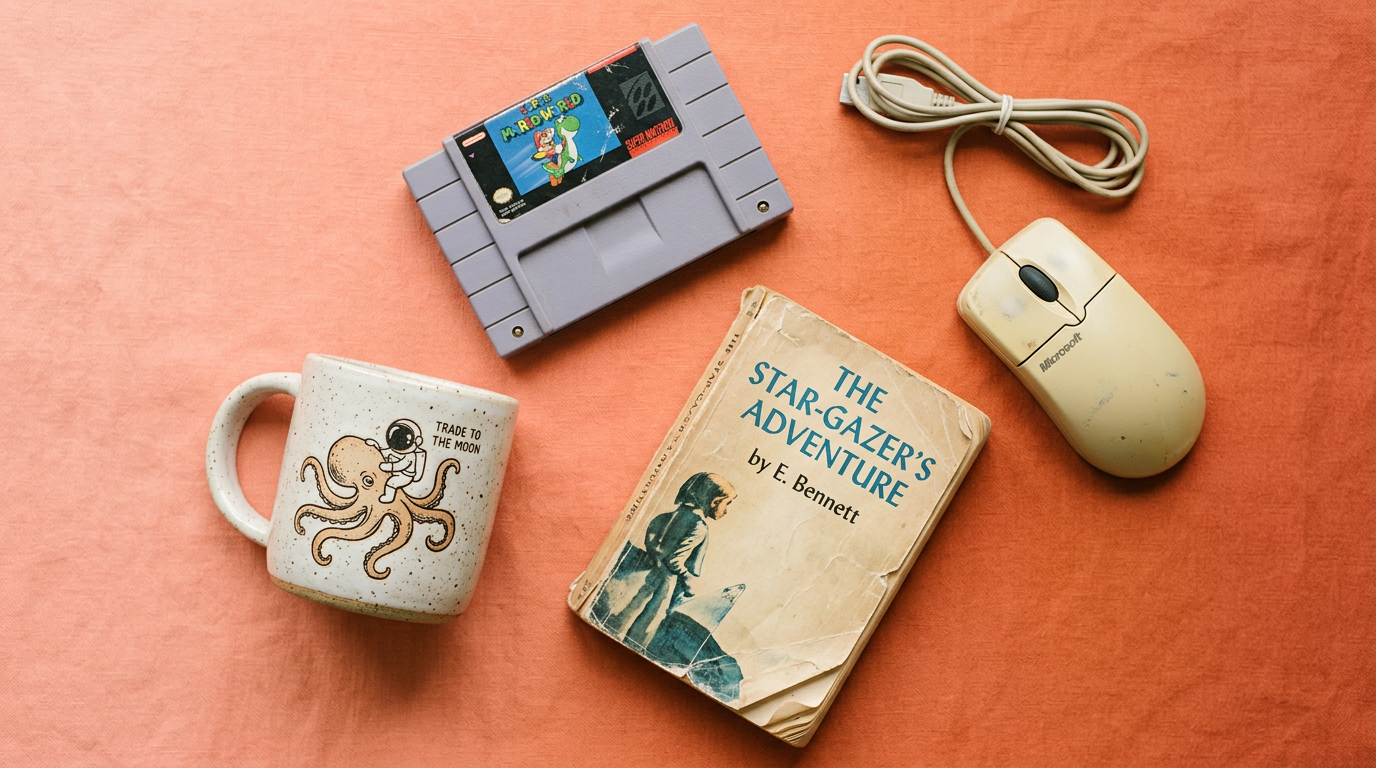
Second, the $20 limit forces creativity. If you started with $500, you could just buy a used iPhone and find a trade easily. With twenty bucks, you can’t buy your way in with an obviously high-demand item. You have to be clever. You must hunt for hidden gems in thrift stores, garage sales, and flea markets. What's sitting on that dusty shelf that has a niche, passionate following? Is it a vintage board game? A first-edition book by a cult author? A piece of retro tech?
This hunt for value is a skill in itself. Our guide to the best starter items for a trade up can give you some killer ideas. Starting with a smaller amount forces you to develop your eye for what has potential value versus what just has a price tag. It's a masterclass in market dynamics, taught on a budget.
Ultimately, starting your trade up quest with just $20 connects you to the core psychology of trading up. It’s about building momentum from a small, manageable win. That first successful trade—turning your $20 purchase into a $30 or $40 item—provides a dopamine hit that fuels your motivation for the next, more ambitious swap. It proves the concept and transforms you from a spectator into a player.
Your Game Plan: How to Win the $20 Trade Up
Alright, enough theory. You need a concrete plan. Follow these steps, and you’ll be on your way from a crisp bill to your big-ticket dream. This is how to start a trade up challenge the right way.
Step 1: The Initial Purchase
Your first item is everything. It sets the tone for your entire journey. Your goal is to find something you can acquire for $20 or less that someone else will value at more than $20. Think unique, niche, or useful.
- Unique & Niche: Look for items with a dedicated fan base. Vintage band t-shirts, old video game cartridges (think Nintendo 64 or Game Boy), collectible figurines, or interesting art prints. Someone, somewhere, is looking for that exact thing.
- Useful & Functional: Think about immediate needs. A good-quality ergonomic mouse, a small but sturdy bookshelf, a set of kitchen knives, or a barely-used yoga mat. The value here is its utility. Someone whose mouse just broke will gladly trade something they don't use for a quick replacement.
Forget sourcing from big retailers. Your hunting grounds are thrift stores, garage sales, estate sales, and online marketplaces where people are clearing out clutter, not maximizing profit.
Step 2: Finding Your Trade Partner
Once you have your item, you need to find its next owner. You could post on chaotic platforms like Facebook Marketplace or Craigslist, but you'll spend half your time fending off lowball offers and no-shows. You need a dedicated arena for serious traders.
You need Flipuz. Our app is built for exactly this purpose. It’s not a garage sale app; it’s a trade-up engine. You list your item, set what you’re looking for (or just see what’s out there), and swipe through items from other motivated traders. When you both swipe right, it’s a match. No endless scrolling, no spam. Just pure, efficient trading.
Step 3: The Art of the Pitch
How you present your item is as important as the item itself. Don't just snap a blurry photo and write “Old lamp for trade.” Sell the story.
- High-Quality Photos: Clean the item. Find good, natural lighting. Take pictures from every angle. Show it in use if possible. Make it look desirable.
- Compelling Description: Be honest about its condition, but focus on its strengths. Is it a “vintage mid-century modern desk lamp that adds a touch of retro cool to any office”? Or just an “old lamp”? Tell the buyer what it can do for them. Mention you're on a trade-up challenge—it adds a fun narrative that people often want to be a part of.
When you match with someone on Flipuz, your opening message matters. Be direct, polite, and explain the mutual benefit. “Hey, I love your skateboard. I’m doing a $20 trade up challenge, and I think my vintage camera would be a perfect fit for your collection. What do you think?”
Step 4: Executing the Swap Safely
When you’ve agreed on a trade, it’s time to meet. Safety is non-negotiable.
- Meet in Public: Always choose a public, well-lit location. A coffee shop, a police station parking lot (many have designated exchange zones), or a busy shopping center are all good options.
- Inspect the Item: Before you hand yours over, thoroughly inspect the item you’re receiving. Make sure it matches the description and photos and is in the condition you expect.
- Trust Your Gut: If something feels off, it probably is. Don't be afraid to walk away from a trade. There will always be another one. Review our full safety guidelines before your first swap.
Real-World Chains and What You Can Learn
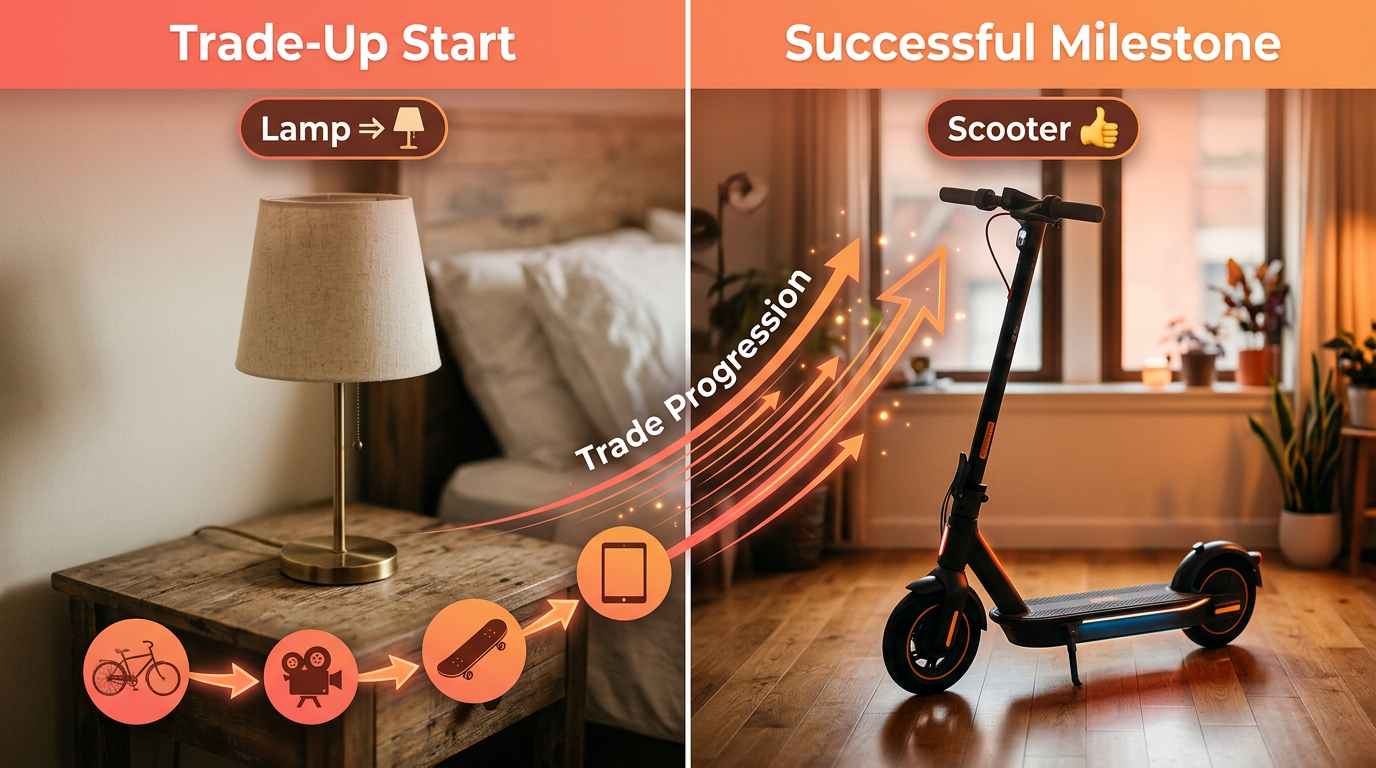
The path from $20 to your goal isn't always a straight line. It's a series of strategic pivots. Seeing how others have done it provides a roadmap and inspiration. While we have plenty of homegrown trade up success stories on Flipuz, let's break down a hypothetical chain.
- Start: You buy a complete box set of a popular TV series on DVD at a thrift store for $10.
- Trade 1: You find a student on Flipuz who wants the DVDs for a movie night. You swap them for a pair of barely-used $40 rollerblades they no longer use.
- Trade 2: You clean up the rollerblades, take great photos, and trade them to a fitness enthusiast for a $70 weighted blanket they found too heavy.
- Trade 3: The weighted blanket is a hot item. You swap it with a remote worker for a $120 ergonomic office chair they replaced after an upgrade.
- Trade 4: A college student needs a good chair for their dorm. Their parents gave them a nice $250 acoustic guitar they never learned to play. You make the trade.
- Trade 5: You list the guitar and trade it for a $400 drone that someone flew twice and then got bored of.
In just five trades, you’ve turned a $10 purchase into a $400 piece of tech. The lesson? You capitalized on subjective value at every step. The student valued entertainment over the rollerblades. The remote worker valued comfort over their old chair. You were the smart intermediary, spotting the potential and making the connections.
This is more than a TikTok trade up challenge; it's a real-world demonstration of supply, demand, and perceived value. Your job is to find the arbitrage—the gap between what someone has and what someone wants—and fill it.
Stop Dreaming, Start Trading: Your Challenge Awaits
You’ve done the reading. You understand the principles. You see the path. The difference between the person who says “that’s cool” and the person who actually achieves their goal is one thing: action.
The $20 trade up challenge isn’t a lottery ticket. It’s a skill you can learn and a game you can win. It requires patience, a bit of charm, and the right platform to connect you with fellow traders.
That's where we come in. Flipuz was built for this. It's the ultimate tool for your trading journey, designed to make finding and executing trades simple, safe, and even fun. Forget the endless scroll of social media marketplaces. Find your tribe of dedicated swappers who are also on a mission.
So, here's the real challenge. Take that $20 bill out of your wallet. Find your starter item. And get on the app. Your journey to your dream car, down payment for a house, or just an epic story starts now. Let’s see if you can make it onto the Flipuz leaderboard.
Ready to prove you can do it? Sign up for Flipuz and start your $20 trade up challenge today.
FAQ
What's the best item to start a $20 trade up with?
The best starter items are typically things with a niche following or clear utility that you can find undervalued at thrift stores or garage sales. Think vintage video games, first-edition books, functional small electronics, unique clothing, or quality kitchenware. Check out our guide on the best starter items for a trade up for a more detailed list.
How long does a trade up challenge take?
There's no set timeline. Some people make a few trades over a weekend, while others, like the original red paperclip trader, take a year to reach their ultimate goal. The pace depends on your items, your goal, your local market, and how much time you dedicate to it. The key is persistence, not speed.
Is trading items online safe?
It can be very safe if you follow best practices. Always use a trusted platform like Flipuz that's designed for trading. When you make a swap, agree to meet in a public, well-lit place like a coffee shop or a police station's designated exchange zone. Always inspect the item thoroughly before finalizing the trade and trust your gut if a situation feels uncomfortable. For more, read our complete safety guide.
What if I get stuck with an item nobody wants?
It happens to every trader. If an item isn't moving, it's time to re-evaluate your strategy. Take better photos. Rewrite the description to highlight different benefits. Or, consider trading it for something of equal or even slightly lesser value that might be more in-demand. Sometimes a small step back is necessary to take two steps forward.
Stop reading. Start trading.
Pick a dream — house, car, Rolex, MacBook. Drop a starter item. Swipe. Flipuz handles the rest.